|
|
When you offer catnip to your kitty, take a pinch from
the bag and rub it between your fingers, this crushes the leaves releasing the pleasant
minty aroma that drives cats wild. Apply the catnip to a toy, scratching post, or just put
a pinch on the floor and watch your cat take a few minutes of pure feline pleasure.
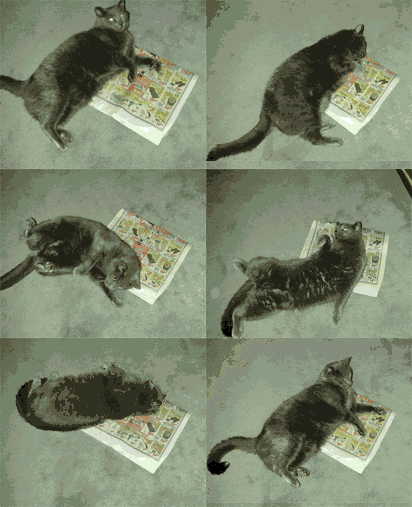
Bailey, the Quality Control Cat, really went wild when we put catnip in a paper bag for him.
Remember, it only takes a little bit of catnip to get your kitty purring, rolling,
playing, scratching, running, jumping, chasing, and generally having a good ol' time.
(Watch those claws kitty!) Normally cats will only
want to do catnip one or two times a day, some like it more, (careful,
you have sharp teeth kitty!) some less, and a few don't like it at all
(the
silly weirdoes!).
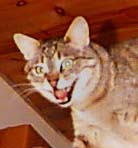
Mom!
Kitty's being a weirdo!
....Here kitty kitty.
meow! |
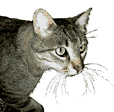 If you don't see his mug
on the bag, If you don't see his mug
on the bag,
it ain't Big
Poon's Catnip!
 Why is his name Big
Poon, Why is his name Big
Poon,
take
a look for yourself!
|
Read
about some of Big Poon's happy customers!
Big
Poon's Home Page
|
|  Now, please understand that Big Poon and his human
helpers are not out to make their fortune selling catnip. We are not some big company
hiding behind some helpless pussycat. We're just a couple of humans who have been asked
(well, told) to share the joy of Big Poon's Very Best Catnip with as many other
kitties as possible. Selling catnip also let Big Poon and Bailey help
out the Iowa County Humane Society. Now, please understand that Big Poon and his human
helpers are not out to make their fortune selling catnip. We are not some big company
hiding behind some helpless pussycat. We're just a couple of humans who have been asked
(well, told) to share the joy of Big Poon's Very Best Catnip with as many other
kitties as possible. Selling catnip also let Big Poon and Bailey help
out the Iowa County Humane Society.
Since Big Poon is no longer with us, he can not tell us what to do. Thus, we have stopped selling catnip online.
Catnip availability
|
NO CATNIP!
SORRY, WE HAVE NO CATNIP TO SEND!
We are no longer selling catnip online.
|
Thank you to everyone who purchased Big Poon's catnip, supporting ICHS! |
|
 |
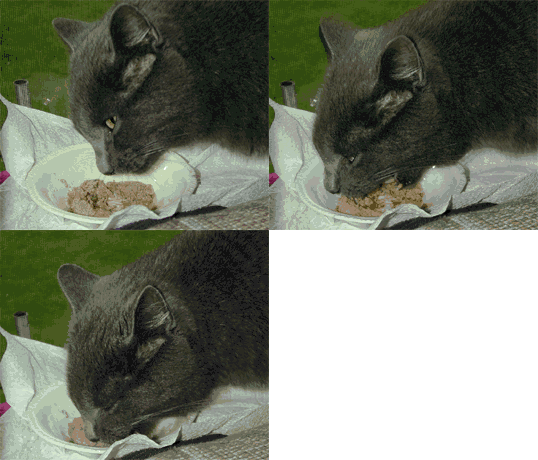
"Wow, I really get hungry the morning after
testing Big Poon's Very Best Catnip.
And, I test Big Poon's Best Catnip most every night! -
Meowowow!!"
-Bailey T. Cat, Q.C., C.E.
Bailey is no longer with us.
After 26 years of life he passed
in the spring of 2012. RIP Bailey.
(These photos are from 1999)
|
Home page |

(© 1997,
National Research Council of Canada, Ottawa, Canada K1A 0R6)
- The generic name Nepeta is said to have been derived from the town Nepete in
Italy where catnip was once cultivated (Bunney 1992).
- In the belief that catnip roots made even the kindest person mean, early American
hangmen consumed catnip roots before executions to harden themselves for their work
(Castleman 1991).
- Catnip is by no means the only plant species known to elicit the catnip response in cats
(Tucker and Tucker 1988). The following have also been reported to affect cats (some notes
are provided where plants may be available in North America, for those wishing to test
their attractiveness to felines): Actinidia kolomikta (Rupr. & Maxim.) Maxim.
(miyama-mata-tabi; occasionally cultivated in North America); A. polygama (Sieb.
& Zucc.) Maxim. (silver vine, mata-tabi; occasionally cultivated in North America); Boschniakia
rossica (Cham. & Schlecht.) B. Fedtsch. (a plant parasite of the roots of alders,
found in northern areas); Lippia javanica (Burm. f.) Spreng.; Menyanthes
trifoliata L. (buckbean, a bog plant found in North America, occasionally in bog
gardens); Nemophila menziesii Hook. & Arnott (baby blue-eyes, an annual often
grown in gardens); Origanum dictamnus L. (dittany of Crete, discussed in this
book); Teucrium marum L. (marum, cat thyme, a Mediterranean shrub sometimes
cultivated in North America); Valeriana celtica L. (a wild native of the Alps); Valeriana
officinalis L. (a common valerian, garden heliotrope, cat's valerian, a garden plant
that has become naturalized in Canada and the U.S.); Vaburnum opulus L. (cranberry
bush, an ornamental bush with edible fruit widely grown in the Northern Hemisphere).
- Both cats and rats are fond of Valeriana officinalis (mentioned above), and it
has been used as a bait for trapping wildcats and rodents (Morton 1976).
- Nepetalactone chemicals responsible for the intoxication of cats seem to be similar to
the natural sedatives (valepotriates) in valerian, supporting the traditional use of
catnip as a mild tranquillizer and sedative (Castleman 1991).
- The young twigs and leaves of Actinidia polygma (mentioned above) have been used
for centuries in Asia to tranquillize lions and tigers in zoos (le Strange 1977).
- Catnip growing near houses has long had a reputation for repelling rats, no doubt
because the plants attract cats.
- Catnip, itself sometimes referred to as cat-marihuana, was used in the 1960's as a
substitute for marihuana, apparently producing visual and auditory hallucinations when
smoked (Grognet 1990). Tyler (1993) castes doubt on the mind-altering properties in humans
alleged for catnip.
- The physicians who first described the drug use of catnip by people, published their
findings in The Journal of the American Medical Association in 1969 with a drawing
of catnip labeled as marihuana and vice-versa. Over 1600 letters were received by the
editor pointing out the mistake (Tyler 1993).
- Cats tend to leave catnip plants alone, unless the plants are bruised and so release the
attractive chemicals. There is an old saying about catnip (Grieve 1931):
- If you set it, the cats will eat it,
- If you sow it, the cats don't know it
The rationale is that catnip grown from seed will not be bruised, while transplanted
(i.e. "set") plants will usually be bruised during planting.
- Catnip has been shown to increase the frequency of catnaps in chicks (Sherry and Koontz
1979).
- Mustard oil (see Brassica in this book) and asafetida (the fetid gum resin of
various Oriental species of Ferula (of the carrot family), formerly used in
medicine) are thought to repel cats (Duke 1985).

"Catnip high," prepared by B. Brookes.
(© 1997, National
Research Council of Canada, Ottawa, Canada K1A 0R6)
|
 Bailey
T. Cat,
Bailey
T. Cat,